In Render, the Edit Tool allows the user to make edits to a passage instead of re-recording the entire audio draft.
In order to use the Edit Tool, it must be enabled in the Workflow Configuration. Please see the article “Configure Workflow: Settings for Stages” for details on how to enable it. Edit is enabled by default only in the Consultant Revise substage.
Once inside the Revise step, select the Re-record icon to get to the Revise: Draft Record page.
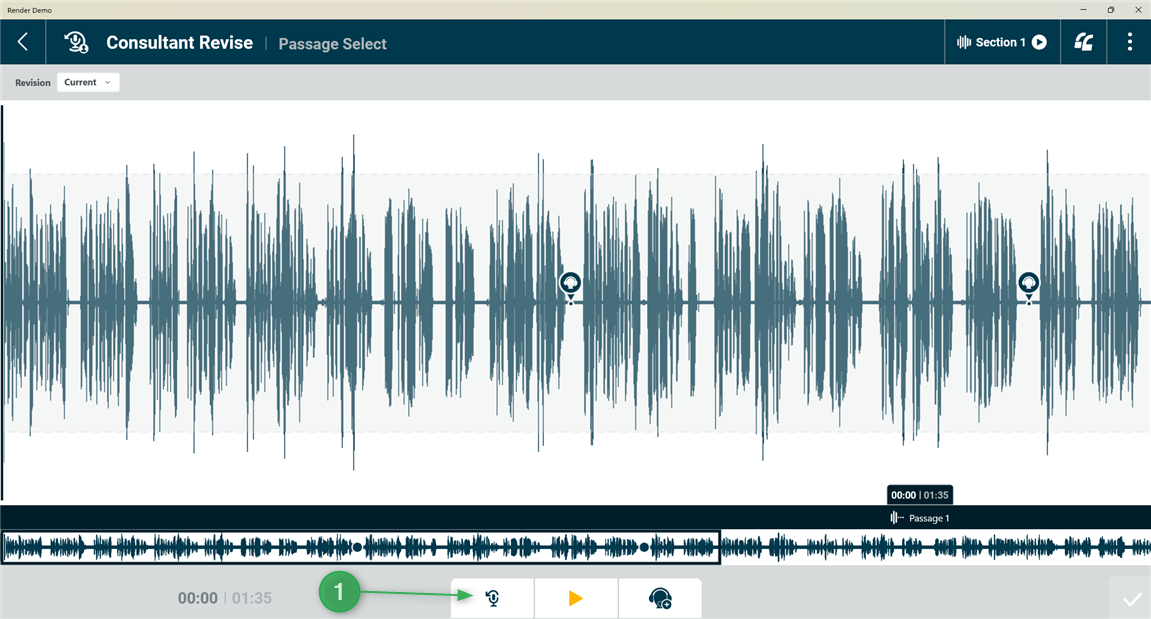
The Edit Tool is available from this page.

- Consultant Notes: These bubbles will be the same ones you saw in the Passage Select screen earlier for this passage.
- Current Draft version: This star on tile #1 indicates this is the current draft with feedback notes. New drafts (or edits of the current draft) will appear in the other tiles.
- Edit: Use the Edit tool to make changes (deletions and or additions).
Preparing to Edit
Most often a section will appear in a Revise stage with feedback in the form of notes from Peers or Consultants, or flags with community responses.
Known Problems:
- If Translation Teams decide to use the Edit tool to accomplish improvements to a passage draft, they will lose access to the feedback when they enter the Edit tool.
Workaround: Before clicking/tapping the Edit button, teams must make mental or written notes about each change they want to make to the draft based on the feedback. These mental or written notes should include the location (time stamp) in the draft and the specific change - an addition, a deletion, or a change - to be made. This is cumbersome and requires a literate team member (or one with a really great memory!) to make these notes.
Fortunately, with the arrival of Render 3.13.2, the edit button now appears on every tile that has a recording. This means, teams can make one edit at a time.
Imagine the Consultant made two notes. After listening to both notes the team realizes they need to make a change to their draft for each note (thus, two changes). The team can then:
- Put the cursor on THE LAST note (we recommend beginning your edits with the LAST note and working back in the draft to the first note) and write down or remember the TIME STAMP of that note.
- Open the note and reply to the Consultant's note (including the translation team's decision to make a change). Then, close the note window.
- Click/tap the edit button to open the editor.
- Make the desired edit at that time stamp.
- Click/tap the Next button to return to the Draft record screen.
- Repeat steps 1-6 above but with the next note to the left (which, in this example is the first note)
Draft Edit
The Draft Edit screen is where you can remove portions of the draft or add new audio to it.
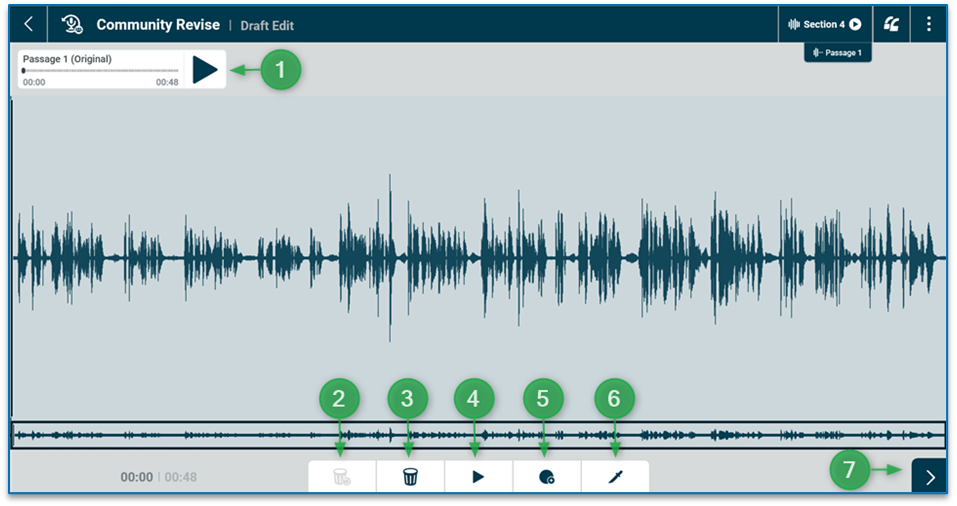
- Play: the original Draft remains available for playback even after you have started your modifications.
- Recover last deleted segment: press to recover the last segment you deleted.
- Trash Can: deletes the segment of the audio draft that is actively selected (the active segment is identified by a dark grey background).
- Play: play button.
- Add Audio: select the point in the waveform where you want to add audio, then tap the Add Audio button to open a pop-up which allows you to record and add new audio (see Adding Audio example below)
- Cut: cuts the audio waveform into segments that can be deleted (see Removing Part of the Drafted Audio below for details).
- Next: Saves your modifications and returns to the Draft Record screen.
Removing Part of the Drafted Audio
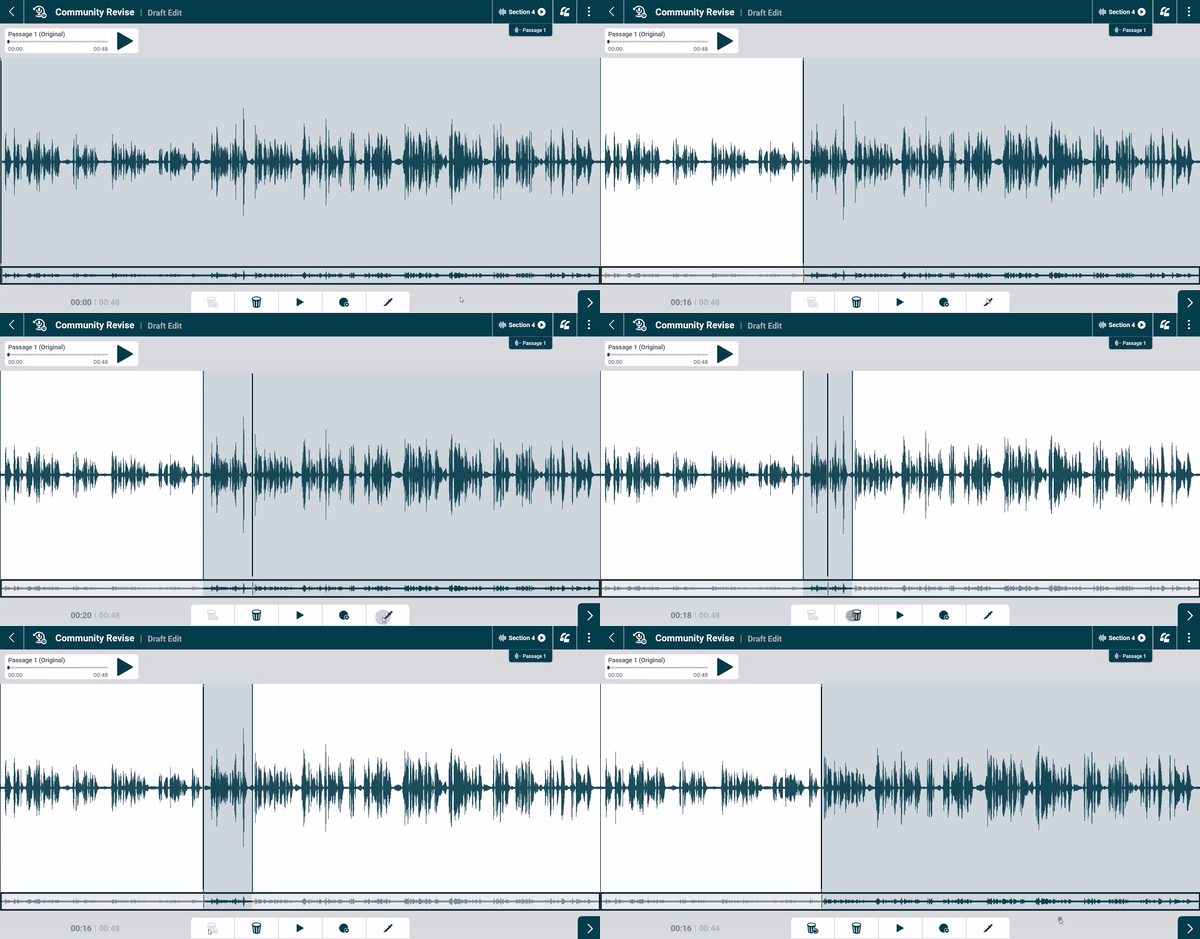
Steps to remove a segment of the audio:
- Select the point in the audio waveform at the beginning of the segment you want to remove.
- Tap the Cut button to make a cut at that point.
- Select the point in the waveform at the end of the segment you want to remove.
- Tap the Cut button to make a cut at that point.
- The portion of the audio you want to remove is now its own segment. Select that segment by tapping somewhere between the beginning and ending cuts you made. The segment will turn gray indicating it is active.
- Select the Trash Can to delete the active segment.
- These steps can be repeated as needed.
- Some rules of thumb: a) make cuts only in the silent space between utterances; b) delete/replace full phrases or sentences, not just a few words; c) replicate the initial recording conditions as closely as possible. Use the same person as in the original draft, use the same microphone, use the same environmental conditions (preferably a recording booth is used for all recording - drafts or edits).
Adding Audio

Steps to add audio:
- Select the point in the audio waveform where you want to start the new audio.
- Tap the Add Audio button to open the recording pop-up.
- Select the Record button and record your audio.
- Select the Stop button when you have completed recording.
- Select the Up Arrow to save the recorded audio. The pop-up will automatically close and the recorded audio will be added to the draft.
Returning to the Draft Screen
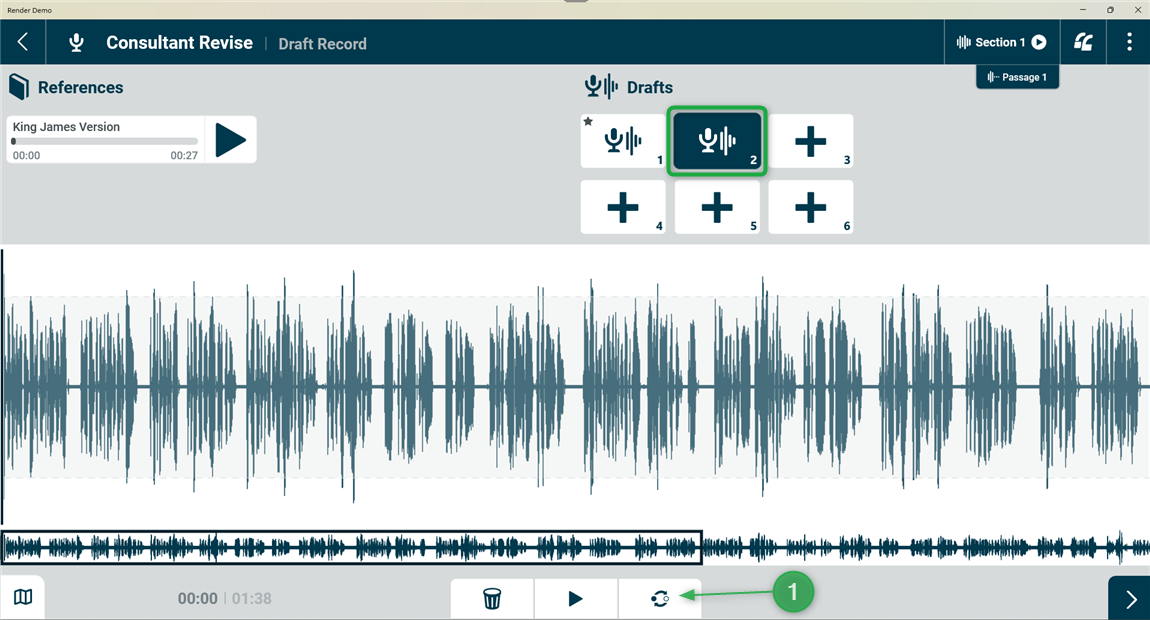
When you have completed editing the audio, and tapped the Next button, Render will return to the Draft Record page.
The modified Draft is automatically placed in the next available Draft slot (boxed in green in this example). Also notice that the Edit tool is now available for every tile that has a recording (1). This means that users are no longer forced to make every edit in one editing session. They can now make one (or more) changes at a time and then edit that edited draft to make the next change(s).
If a team continues like this to create new recordings in each of the 6 Draft tiles by editing or by re-drafting, and then edits the 6th tile, they will encounter a special popup screen which enables them to choose which of the recordings they will replace with this new recording. However, you will notice that tile #1 (the original) is protected and cannot be replaced.
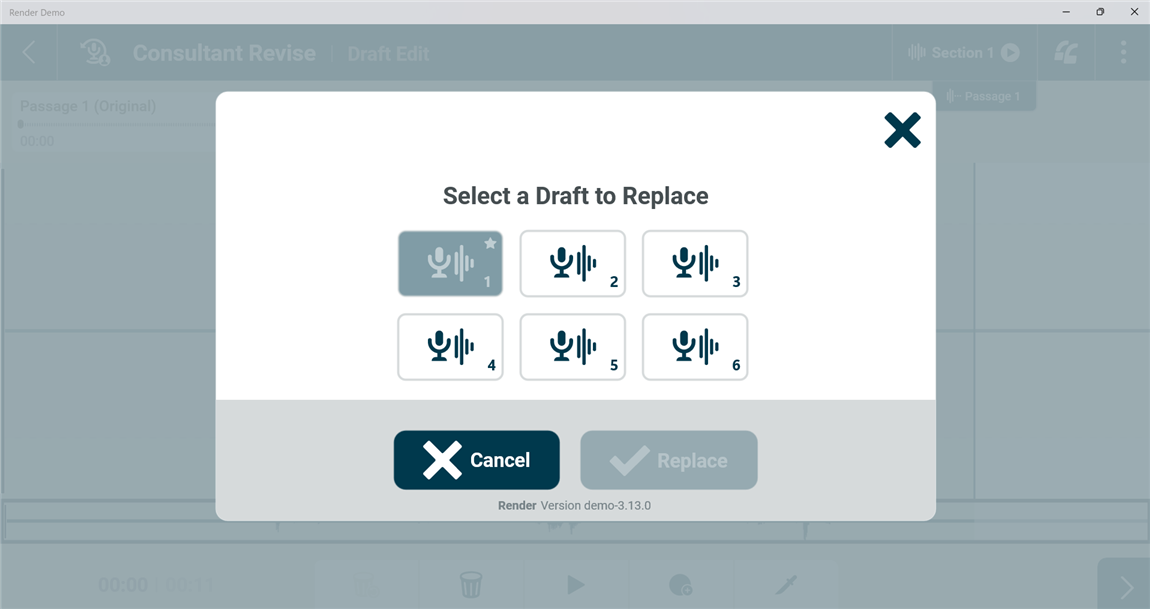
WARNING: Don't lose track of which tile has your best recording!
The original Draft will still be available in Draft Slot 1. When you proceed out of the editor and then out of the Draft screen Render will prompt you to select one of the drafts (Draft Select). Be sure to choose the right one!
Was this article helpful?
That’s Great!
Thank you for your feedback
Sorry! We couldn't be helpful
Thank you for your feedback
Feedback sent
We appreciate your effort and will try to fix the article